
How to Think about Remodeling
ORIGINALLY APPEARED IN 2025 METHOW HOME, PAGE 33-34 ON MARCH 20, 2025.
BY MARY & RAY JOHNSTON
Building a new house is exciting. The journey starts with a fresh landscape that has views, vegetation, rock outcroppings and topography. That is hardly a blank canvas, but one that is able to accommodate any number of dreams and desires.
In contrast, a remodel might seem like a compromise, inhibiting imagination and narrowing options. Remodeling an existing structure does narrow options, but that not necessarily a bad thing. The constraints of existing conditions can foster creativity and impose discipline. Every building has a story that can be continued and edited.
The original story of a house may have been fine at the beginning, but time brings change: a family grows, a family becomes smaller, accessibility needs change, and even landscapes change.
As with living organisms, buildings can change too. With thoughtful design, they can improve with time. Buildings can learn new roles to fit new purposes and circumstances. An added benefit of remodeling what you have is that it is sustainable. The idea that it is better to repair something rather than throw it away, is a very Methow value.
Here in the Methow we have seen changes that alter our relationships to our houses and workspaces. The pandemic made remote work a necessity for many, and then an option that was appealing.
But more time home meant more time to notice inadequacies of home. Closets were too small, privacy was hard to come by, the best views and exposures were not available because the windows were in the wrong place and not the right size. The solution: a remodel!

A wall between the dining and living rooms was knocked down and views were exposed in every direction through strategic window placement and indoor/outdoor connections / Photo by Ed Sozinho
Study the original
Before deconstructing and re-constructing a building, it's important to understand the logic (or lack of logic) that went into the original design. Is that kitchen so small because the original owners didn't like to cook, or was the budget too tight to have a spacious kitchen? Is the house turned away from the view because of too much sun exposure, or is the house from a different era when views were not a main concern? Does the house sit uncomfortably on its site because a stock plan was used that never accounted for topography or landscape features?
From that analysis, it's possible to imagine how things could work differently. What if that wall could be opened up to the view that had been denied by the original design? What if the once-expedient kitchen could now be a place where the pleasure of cooking and eating was embraced? How about adding a real bedroom to that original one-bedroom cabin so that friends and family could visit and be comfortable? Wouldn't it be nice if the windows didn't leak or the house reflected our aesthetic rather than that of its previous owners? How about the local climate - could we provide better shade in the summer and control snow and ice more efficiently in the winter?

The home’s original kitchen was cramped and closed off from the rest of the house / Photo by JA

A remodel progresses a little differently from a new house. The first step is to understand what is there - what is worth keeping and what is not. The next step is to document what already exists in the form of "as-built" drawings. From these base drawings, fresh ideas spring.
Frequently, homeowners have a good idea of what is needed, but a fresh look might suggest a few options. An experienced architect or designer can help to sort out desires and potential solutions.
The new kitchen preserves the views from over the sink and drasticaly opens up the pass-through to the mid-century home’s living spaces, grabbing more views of the Cascade Mountains / Photo by Quanta Collectiv
Of two or three potential solutions, one will rise to the top and warrant further development. As a direction evolves, the addition of a contractor is essential. Contractors have the most current cost knowledge and can help balance the aesthetic and practical goals of a project against target budgets. They may also surprise the design team with innovative ways to achieve desired aesthetic goals within a confined budget. What makes a great result? A house that is more comfortable and useful, and that reflects the tastes of its owners. The path to this ideal result can be challenging, like discovering that a roof structure is woefully inadequate, or, yikes! mice have made a home in one of the walls.
To make the challenges worth it, think clearly about motive, goals and budget. Assemble a team that can work co-operatively to make your vision a reality.
Our experience

The story of our own remodel journey is a tale of a building that "learned" to adapt to changing conditions.
Twisp Cabin / Photo by Benj Drummond
A friend brought us to the Methow 36 years ago. We were invited to use their cabin and fell in love with the valley, as did our young children, and we realized early on that a presence here was our destiny. We found a piece of land, added improvements like power, a driveway improvement and a septic system, then realized that we could actually begin to build a home, of limited size, simple construction, and few interior walls.
Building our small cabin was a great experience, but as time passed we realized it was incomplete, and didn't quite suit our needs as we spent more time in the valley (eventually moving here full-time), our children acquired partners, and we added an exuberant grandson to the tribe.
Our first move was to build a guest house so visitors could be comfortable. Then we tackled our own quarters. The main house's footprint was 800 square feet.
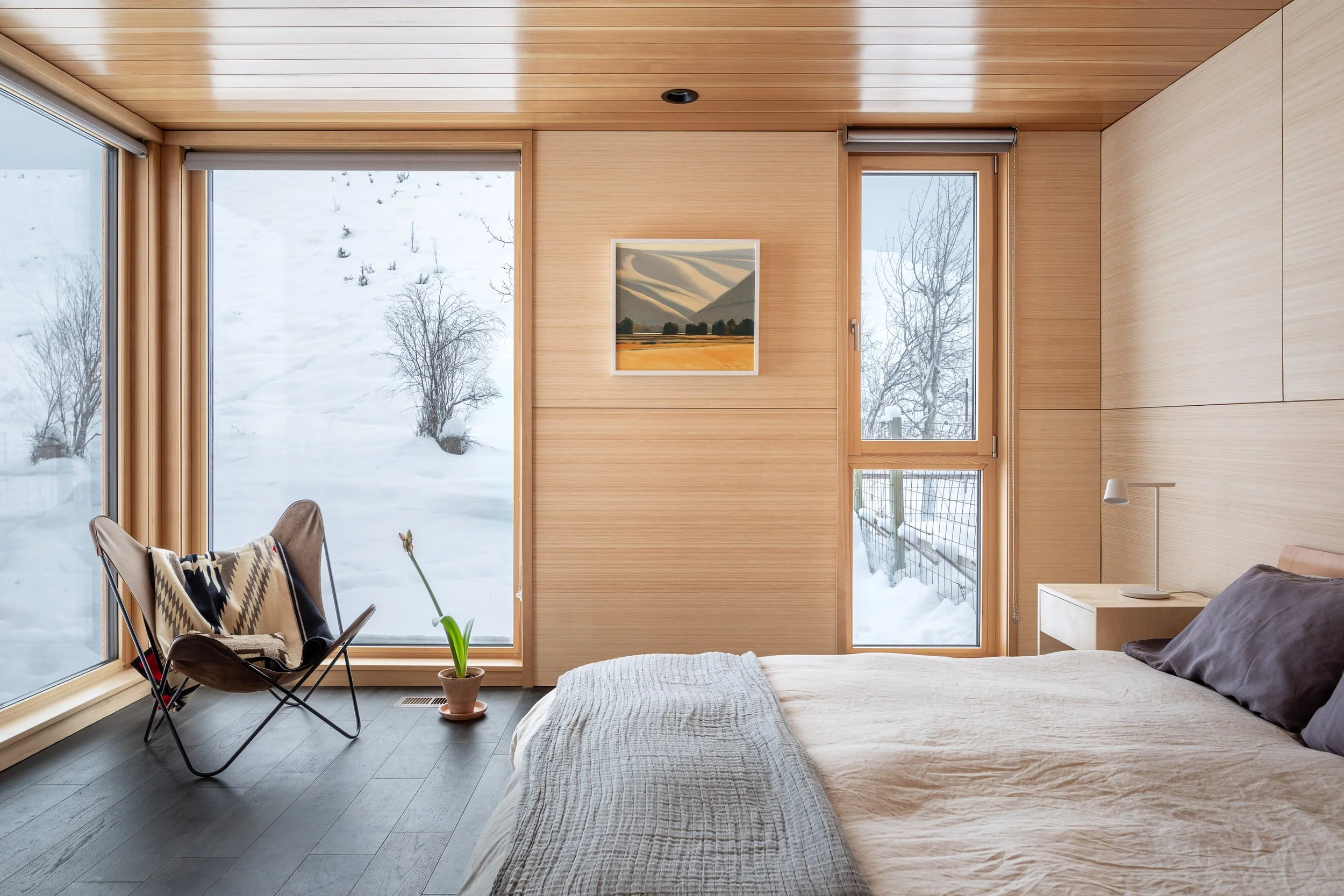
The bedroom was really a large closet, or "bed cabinet" as we called it, and the real closets were scant. We decided to add a 250-square foot primary suite with 12 feet of new closet and a new bathroom. We oriented the new bedroom to the east, a view we had never taken advantage of before.
Twisp Cabin / Photo by Benj Drummond
The guest house and primary suite additions expanded our connection with the outdoors. The main house faces the Cascade Sawtooths. The guest house angles toward the Cathedral Peaks and the new primary suite allows us to wake up to a view of our clutch of pines, a pastoral shrub step bowl frequently occupied by deer, bunnies, birds and now and then a pine martin or bobcat.
Our remodel has refreshed our love for our house by giving us a new view of our surroundings. Our little house learned how to become a bigger house!
We now see the rest of the house through the lens of possibilities. An existing bathroom could be downsized to a powder room. The laundry could be relocated to make a bigger pantry. And it would be great to have a real mudroom! But perhaps we'll take a break and just enjoy the view ofthe pines for awhile.