
Designing around Trees
BY RAY JOHNSTON
Trees are an important part of our environment and contribute to the overall health of our planet and its inhabitants.
Over the centuries, trees and built structures have not balanced each other well. In general, the built environment has displaced the tree canopy. Some communities have escaped this pattern, but many have not.
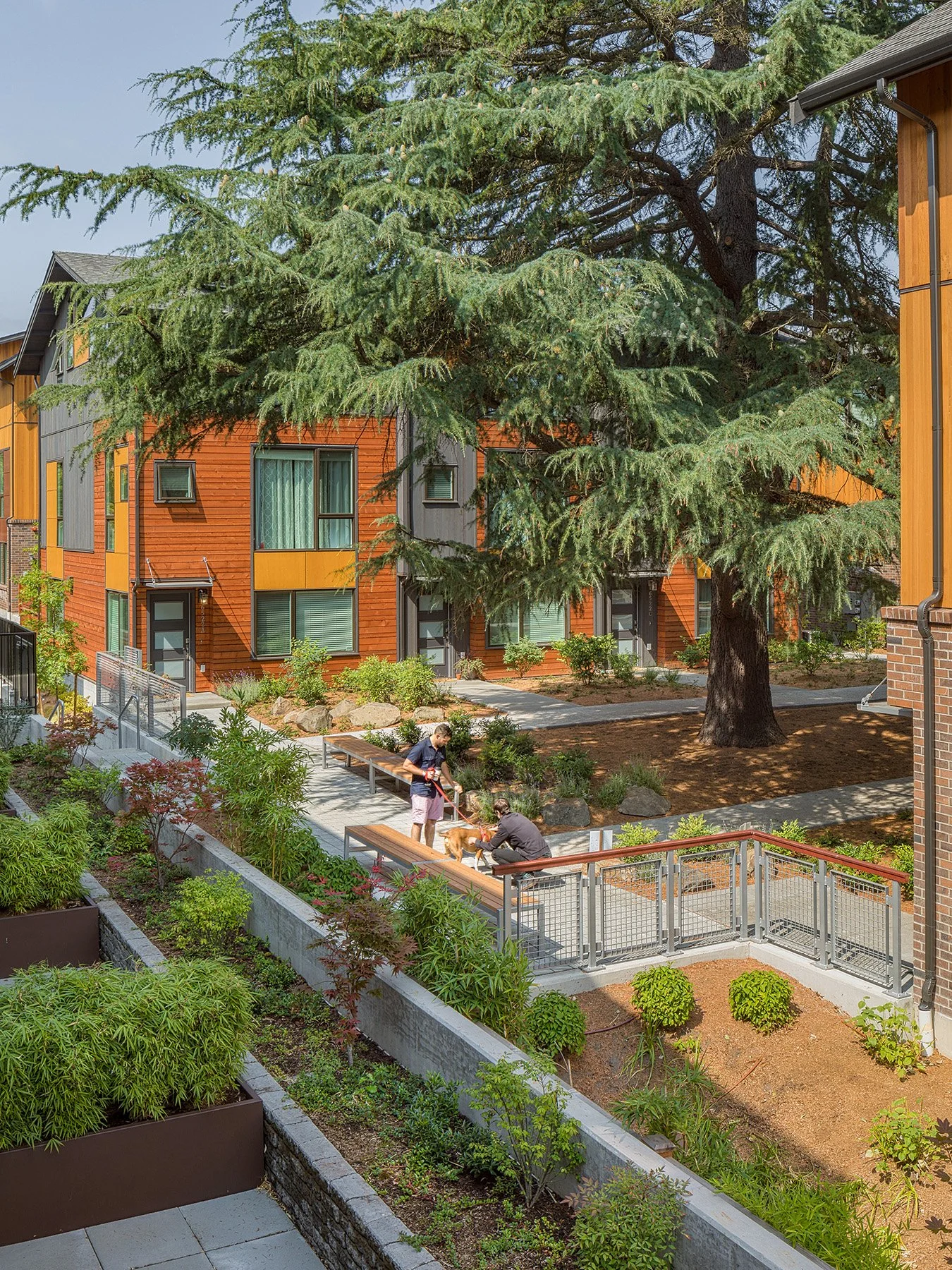
Bryant Heights / Photo by Ed Sozinho
Easter Island and other temperate areas around the globe have seen the loss of arboreal forests. There are bright spots, however. Urban environments in the southeast and northwest U.S., in particular, have maintained a significant portion of their tree canopies. The pressure today comes from the need for greater housing density, which in turn is causing the relaxation of tree ordinances in many jurisdictions and the loss of tree canopy where it is most needed.
This does not need to be the case. When innovative solutions are nurtured by developers and regulatory agencies, trees can be saved and become an enhancement to the built environment rather than a hindrance.
Innovation in this context can take many forms. To begin with, a shift from prescriptive requirements to localized analysis can help save trees. The prescription may call for a high percentage of the area described by the “drip line” of a tree to be preserved, when in many cases the root ball and significant “in-ground” structure of the tree are smaller than the drip line might indicate. This is particularly true of trees that mature next to existing structures. But it is also something that varies with species and climate. With the help of an arborist, tree health near new construction can be maintained. Many examples are available:
At Brooklyn and 50th in Seattle, the Stax project preserves an American Elm on a small lot that has been developed for student housing. The Elm was pruned for a year before to adjust its canopy to fit the new building. Pruning included the removal of branches intruding on the building design as well as root pruning. Ground conditions were enhanced through the removal of contaminants and aeration of the ground surface. The result is a development enhanced by a heritage tree.
Boulders, at the intersection of 75th and Latona in Seattle, is a courtyard development centered on the preservation of a large Scotch Pine. The tree roots were trimmed before construction, and the area was preserved during construction. The tree, combined with a man-made water feature, models the experience of a shaded mountain creek.
Bryant Heights, a multifamily housing complex in Seattle, was developed close to zoning capacity for housing while preserving groves of hemlock, an American Elm, a Deodar Cedar, and various oaks and maples. Each tree was assessed for health and the impact of strategies that were developed to place housing in and around the tree canopy.
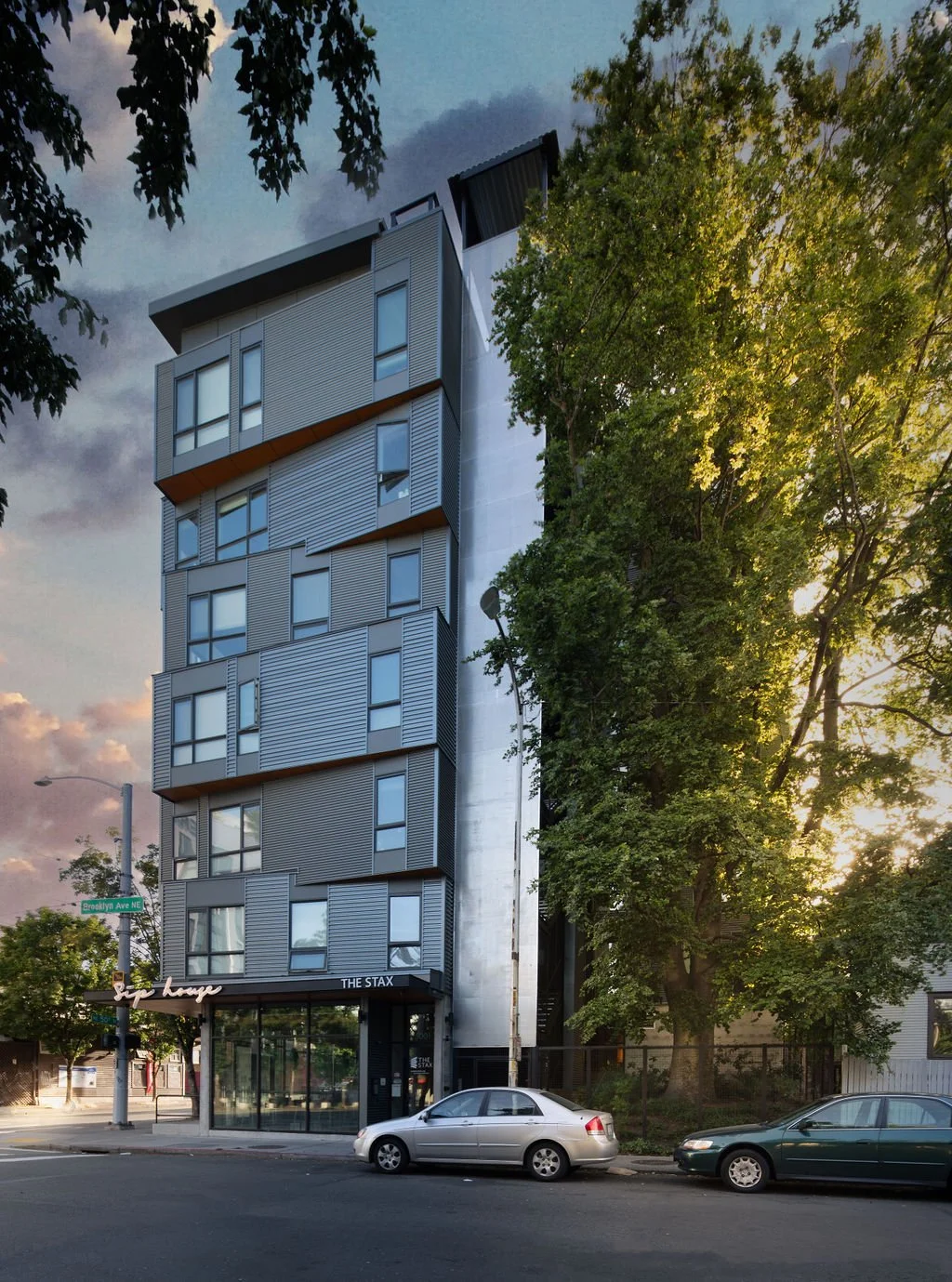
Stax / Photo by Cheryl McIntosh
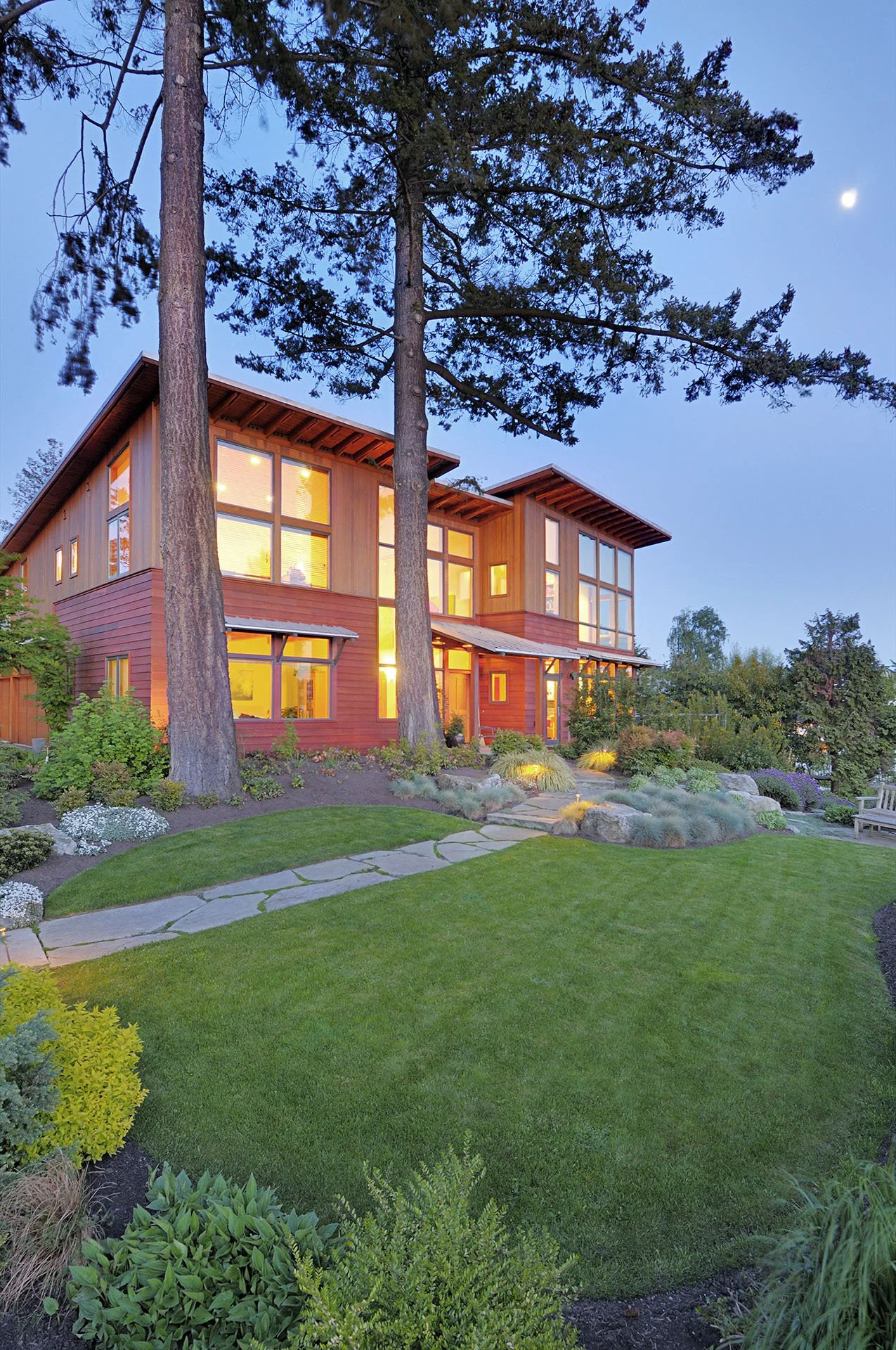
Mercer Island / Photo by Will Austin
On Mercer Island, a house was built next to two mature Douglas Fir trees. An arborist was consulted before and during construction. A former building on the site had altered the shape of the combined root ball, yet some significant roots still intruded into the new building footprint. Instead of cutting those roots and jeopardizing the structural integrity of the tree, foundations were designed that bridged these roots.
At Maple Valley Library, the county Water Quality manual suggested the removal of over an acre of trees to accommodate the new structure and its parking lot. Instead, the design team, using techniques pioneered by NASA, carefully threaded the building, drive lanes, and parking spaces amongst the second-growth forest. Strategies were deployed to protect the roots of trees from damage caused by heavy equipment during construction. Thick carpets of wood chips were installed where equipment paths might damage roots. As a result of this work, 90% of the forest was preserved. A biofiltration strategy was also key. Studies had shown that forest duff was an excellent biofilter for parking lot runoff. A plan to monitor the health of the microbes in the duff at the edges of the parking areas was developed, along with strategies to replenish the health of the duff if needed.