
Working with Trees in the Built Environment
BY RAY JOHNSTON
I grew up in a wooded neighborhood. Trees were everywhere and were an essential part of my youth. As an adult my wife and I currently live on the east slope of the Cascades near the town of Twisp, but we still have an office in Seattle where more than half of our work occurs.
We work on single family projects, mixed use buildings and in the public realm. As our work evolved, the way our buildings interact with their surroundings became a theme. Frequently this means fitting buildings into natural environments and borrowing space from the surroundings to create a strong inside outside connection. Preserving and benefitting from natural landscapes has been integral to our practice.
I have been fortunate to get to work on a number of projects and with a number of clients where the natural environment is a critical element of design. I will share a few projects that demonstrate this ethic and then, hopefully, will have time for questions and discussion.
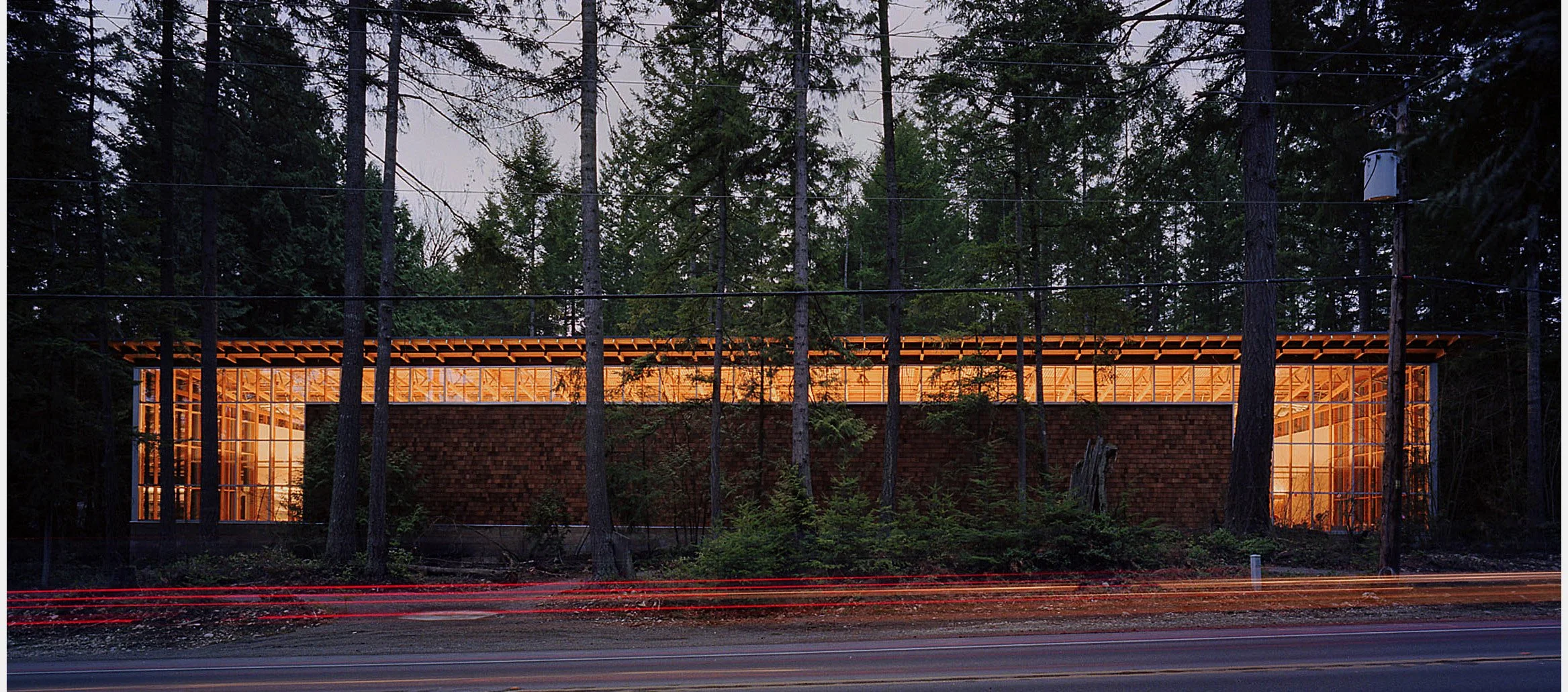
Maple Valley Library
The Maple Valley Library was slated to occupy a two acre site composed of second growth forest. The tendency at the time was for owners and civil engineers to remove large areas of vegetation to make it easy to lay out parking, build buildings and install infiltration pits for stormwater management. While this approach seemed to be indicated by the King County Storm Water Control Manual at the time, we sought a different direction.
On a hot summer day we invited our client group and Maple Valley officials to a meeting in the forest. It was over 90 degrees on the adjacent street and about 80 degrees in the forest. It was cool, soothing and beautiful. We convinced those present to allow us to work with the forest, to fit parking in amongst the trees and to minimize clearing. We developed techniques to move trucks and equipment in the forest without damaging tree roots during construction and we carefully culled trees from areas that had to be occupied or disturbed.
There were other factors: we had a site that could not hold water no matter what. We ran across a NASA study on the biofiltration properties of forest duff. We had an innovation minded City government and developed backup protocols should our non-traditional storm water management plan fail in some regard.
The result was an 11,000 sf footprint and parking for 90 cars. We oriented the library to participate in the forest and to appreciate materials derived from trees. The childrens’ area looks out on a large Vine Maple. The adult lounge is graced by a Cedar Circle just outside the window wall. And, a café like seating area looks out on our storm water infiltration structure which is now covered in moss and a nurse log we moved into the area. The building peaks out of the forest announcing its presence to the folks of Maple Valley. We were able to save 90% of the forest.
A few years later, we were invited by Polygon Corporation to design a North Seattle project on the old Childrens’ Home campus. The campus straddled commercial, multi-family and single family zones. In addition to 16 existing buildings, the campus was occupied by a wonderful range of existing trees, many of them exceptional. Included were an American Elm a Deodor Cedar, Maples, Vine Maples, Oaks, Evergreens and a couple clusters of hemlocks.
Working with Urban Forestry Services we catalogued the trees and developed a site plan that would allow most to stay. The older site development was helpful. Large trees that had grown up next to buildings had root systems that had grown around these buildings so that we could work with existing older footprints. Nonetheless, we applied some of the techniques we had learned at Maple Valley and in other projects to protect tree roots. We also engaged in preliminary pruning to help shape trees and remove unhealthy elements in preparation for the shock of surrounding development.
The result was a 3 story mixed-use building including retail spaces, work-live units and townhouses surrounding an upper level courtyard. 82 housing units, 8 work-live units, 2 retail spaces, and attendant parking resulted. Native plantings were added to the mix in addition to a significant number of street trees, resulting in a dense but natural environment.
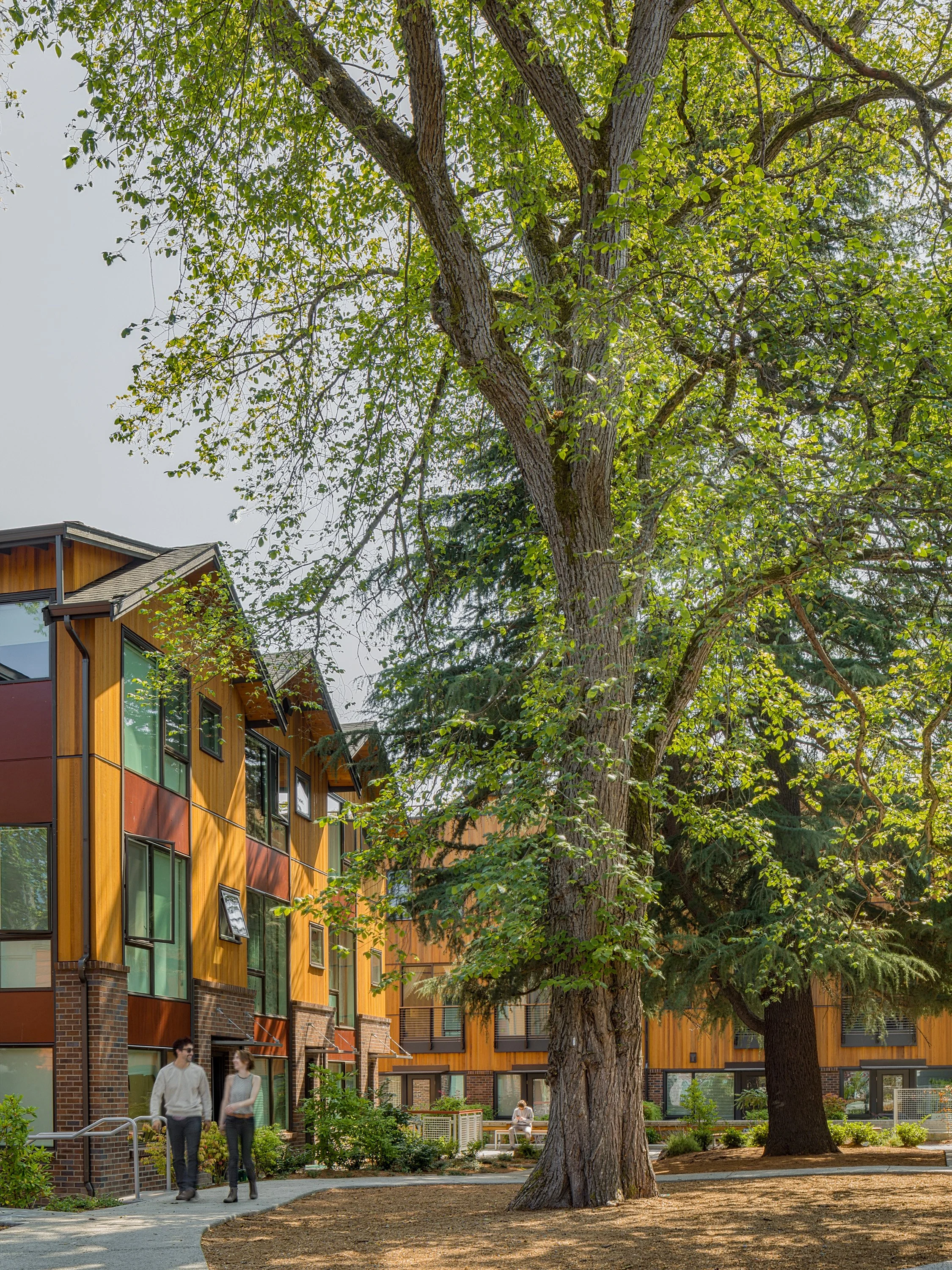
Bryant Heights / Photo by Ed Sozinho
Greenfire Campus
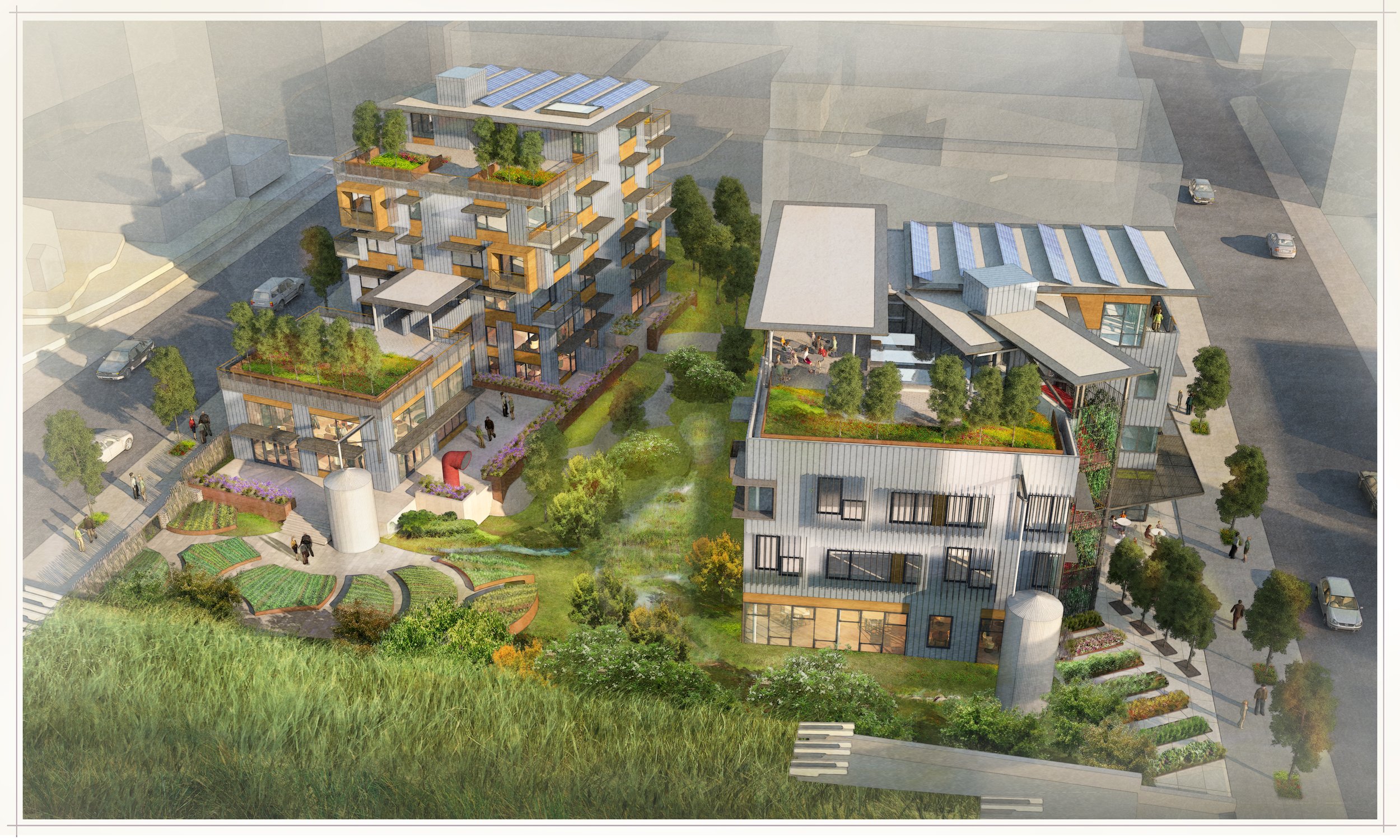
Greenfire Campus / Rendering by JA
Lastly, sometimes there are no trees to protect. This high density site in Ballard was a parking lot. We planted 50 trees in a pattern that evoked the orchard that had occupied the site a hundred years earlier. And, we developed a native riparian zone that allowed for storm water bio-filtration and infiltration. We used a heavily planted sloped timber retaining system which I had seen in very old applications in Scotland and deployed gabions for retaining instead of the more impactful technique of concrete retaining walls. The central riparian zone is nurturing of both flora and fauna and provides respite for the occupants of the buildings.
Read more about how Johnston Architects have designed with trees in the built environment on Ray Johnston’s Substack!